
Even as I was writing yesterday’s post, I had a feeling that there were much more important things I should be writing about, but it wasn’t until later that day that Pete perfectly expressed my feelings in a short tweet.
“The transgender debate,” he wrote, “has become a craft beer on both sides, and some have a vested interest in perpetuating it.” I don’t dismiss this issue as trivial because it affects all women, but politics and the media have a sad tendency to address only one issue at a time, and because it is so easily accessible, it has captured everyone’s attention, while trade, defense, energy, health care, education, and immigration have all receded into the background…”
“I’m incredibly fed up with this,” he concluded. “We really had more important things to do than stop everything to explain to the privileged left why fetish transvestites can’t use the women’s locker rooms.”
As it turns out, only one of these topics—defense—has anything serious to discuss today, not least because of the media’s inability to look beyond the press releases issued by the Department of Defense and its sad tendency to present technical defense-related issues in “boyish” terms, substituting intellectual analysis for captivating simplicity.
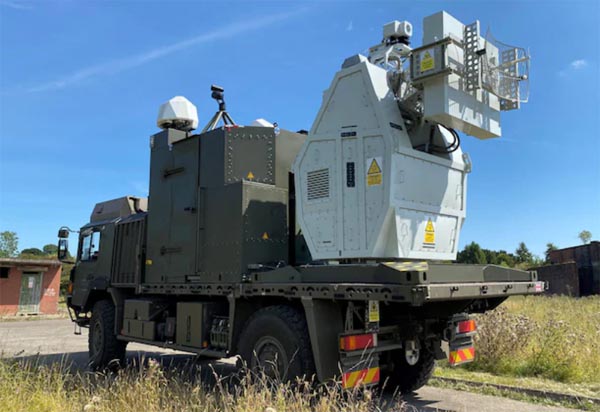
The main issue, in general, is the news of the apparently successful test of the Ministry of Defence-funded Defence Research and Development Laboratory’s Direct Energy Wave (DEW) “radio frequency” weapon, where the experimental device “shot down a swarm of drones for the first time” (pictured).
I first came across this in the Telegraph in an article written by Defence Editor Daniel Sheridan under the headline: “British Army’s innovative radio wave weapon neutralises drone swarm”, with the subheading: “DEW radio frequency radio communication system is a groundbreaking technology that could help stop the dominance of unmanned aerial vehicles in modern warfare.”
However, Sheridan was not alone in falling for the MoD nonsense, as a similar story appeared in The Times under the headline: “MoD energy weapon shoots down drone swarms,” with a longer subheading revealing: “Radio frequency directed energy weapon developed at Porton Down fires intense pulses of radio waves at a fraction of the cost of anti-aircraft missiles.”
Other versions soon spread like diaper rash on a baby’s bottom, including a short report in the UK Defence Journal that simply reported: “British troops ‘shoot down’ swarm of more than 100 drones.”
If we look at the gist of this excerpt, we see that the Ministry of Defence describes the trial as a “landmark step in the modernisation of the country’s air defence capabilities”, where the equipment was able to “detect, track and neutralise multiple drones in a single strike”.
We are then told that with an estimated operational cost of just 10p per shot, RF DEW offers a low-cost alternative to traditional missile systems. And “unlike conventional jammers”, it is claimed, “the system can physically disable targets at a distance of up to one kilometre, making it effective even against resistant or insensitive drones”.
However, while the operational cost may supposedly be 10p per shot, the programme itself is a money-spinner, having received over £40m in public investment, supporting “over 135 jobs in Northern Ireland and the south-east of England”.
Then we get pure, unadulterated propaganda from the Labour defence procurement minister, Maria Eagle, who mutters: “This significant experiment is an example of the power of British innovation, driven by our homegrown industry, technology firms and scientific talent.”
She then adds: “We continue to strengthen our defence sector, adding more cutting-edge capabilities to ensure Britain’s security at home and strength abroad” – a pretty obvious nonsensical claim for a system that is still in the experimental stage and has not even reached the operational prototype stage.
As for the chauvinistic claim about the “power of British innovation,” the US Department of Defence – and other departments – are well ahead of the curve. The GAO reports that DEW technology was critical to the 2018 National Defense Strategy and was spending about $1 billion annually on research and development for the three years through 2023.
But even in 2023, there were warning signs about the technology’s viability for defense applications, outlined in a larger GAO report that highlighted the difficulty of moving from the experimental phase to the operational level—a gap that the GAO called the “valley of death” in which many initially promising projects have disappeared.
Interestingly, of the three U.S. military branches involved, the Army appears to be the furthest along in its program, having just awarded a contract to a specialized firm to develop a weapon for use against small drones (weighing 1,320 pounds or less).
Importantly, however, the Army has been slow to move away from the radio frequency route, which the Americans call High Power Microwave (HPM) systems, and instead appears to be focusing on high-energy lasers – and this is just one of a wide range of technologies being investigated, including kinetic weapons.
However, in 2023, it was reported that the US military had expanded its investment in High Performance Microwave (HPM) weapons, with one of the major contracts being a $66.1 million deal to acquire the Leonidas C-UAS system from specialist company Epirus as part of the US Army’s Indirect Fire Protection – High Power Microwave (IFP) program.
Unlike the British system, this one actually entered service in 2020, with a third-generation variant introduced in April 2022. The prototypes were later integrated into the US Army’s Stryker platform, with deliveries expected to be completed in May 2024.
It is not surprising that the development of high-frequency (HF) guidance technology is not being rushed. To some extent, the technology is already redundant, as the Russians (and now Ukrainians) use fiber-optic, wire-guided drones that are not protected against electronic countermeasures (ECM) and can be relatively easily “hardened” to protect against directed electromagnetic energy weapons.
Moreover, contrary to the fantasies of science fiction writers and more excitable media representatives, swarms are not the problem. Ukraine’s experience shows that the problem lies in the sheer density of individual drones, with not a single square meter of the battlefield unobserved.
Here, the lifespan of the clumsy equipment on the back of a 6-ton truck would be measured in minutes, especially considering its power consumption dictates a bulky generator set with a heat signature that would be detectable from space. If used against equal enemies like the Russians, it would quickly become the recipient of a FAB planning bomb, which would quickly reduce it to smoldering rubble.
Another point that arises is the limited range of the system, which, at 1 km, is hardly impressive. For example, full coverage of Ukraine would require over 400 units, which would be prohibitively expensive. And this range is likely the limit of the technology – the power requirements increase exponentially with increasing range, to the point where the requirement becomes unmanageable.
As noted in a more insightful report, specifically at a Bulgarian military facility, the weapon has demonstrated its ability to engage targets at a distance of around one kilometre (sic), but scaling this capability to longer distances or more complex scenarios remains a challenge.
There is also an element of cynicism in the cost estimates. “10p per shot” sounds extremely valuable, except that it is a pulsed weapon whose beam travels at the speed of light. According to US sources (cited in the GAO report), it fires the equivalent of hundreds or thousands of rounds per second. The actual cost of a destroyed target may be a better indicator, which, when capital costs are added, may not represent such a good value.
This is not to say that DEW is not worth investigating, although a high-energy laser does seem to be a more promising route, the one chosen by the Royal Navy with its DragonFire system, which is expected to be installed on a warship by 2027.
However, what is suitable for a warship may be much less suitable for land combat, where the threat environment is very different. For example, Russian FPV operators have learned to navigate their drones at head-on through forests, from where they park them by the side of the road, inactive, covering their sensors until a target appears.
In a more realistic threat assessment conducted last year by the US Joint Counter-Unmanned Systems Command (JCO), officials concluded: “The challenge of the profile really meant that no single feature, no single capability, kinetic or non-kinetic, by itself could realistically defeat that profile.”
This led Colonel Michael Parent, the JCO’s chief of acquisition, to conclude: “You really need a full systems approach, a multi-layered approach, because we’re talking about a very large profile, 50 or more [threats]… coming from different angles, different speeds, different sizes.”
This was done in response to a simulated swarm attack, but the comments are entirely relevant to the broader operational situation. Not surprisingly, the JCO is currently evaluating nine counter-drone systems, and each one of them addresses this DoD’s gibberish quite accurately.
Instead of swallowing it all whole, we need a better, more informed media that can evaluate extravagant claims and see beyond the PR hype. This is about defending the nation, not some reality TV show.