
Fourteen strike UGVs from DevDroid, FRDM, UGV Robotics, TEMERLAND, Rovertech, Tank Bureau, Ark Robotics, and others took part
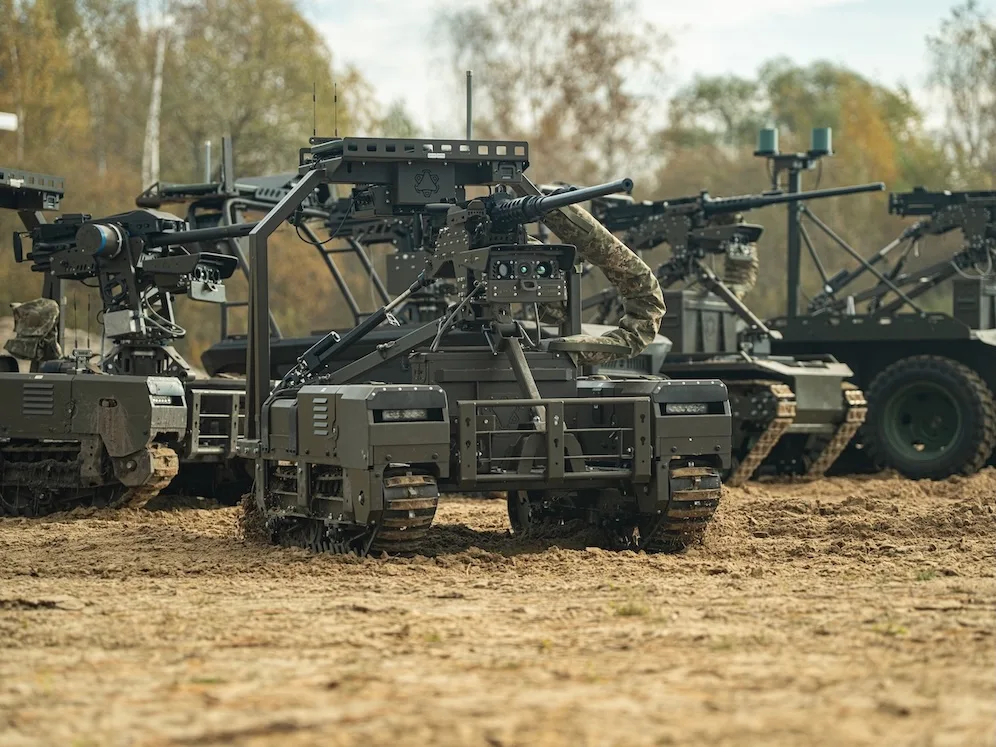
On 22–23 October, a crash test of strike UGVs took place near Lviv. The aim was to test strike UGVs in conditions close to real combat, to give manufacturers honest feedback and speed up the delivery of reliable solutions to the front. Fourteen strike UGVs from DevDroid, FRDM, UGV Robotics, TEMERLAND, Rovertech, Tank Bureau, Ark Robotics, and others took part. Defender Media shares photos and details from the event organisers.
How the crash test went
The test route simulated battlefield conditions — mud, heavy terrain, debris, trenches, and mined areas. Manufacturers operated their UGVs from a field dugout, with no direct line of sight, facing delays and periodic signal losses. They relied only on limited camera feeds from the UGVs and a Mavic drone for situational awareness in low-visibility conditions.
The vehicles had to cover more than 5 km of rough terrain to reach a firing line and perform live firing. Conditions were equally tough for all participants: if a UGV stopped, crossed the safety tape, or got stuck, its run was over. The manufacturer wasn’t allowed to retrieve it, and the immobilised UGV became an obstacle for subsequent participants.
Some developers were disappointed by their results, but the experience became a catalyst for quick improvements — the same day, several teams began coordinating with contractors to replace components that had failed to perform in near-combat conditions.
The crash test followed the Strike UGV Forum held in Lviv in late August. One company whose product had been criticised during a panel discussion managed to fix its issues and demonstrate a successful run this time.

Following the trials, several teams received specific recommendations for improvement — including manoeuvrability, mounts, batteries, and cable protection — aimed at unifying critical nodes and establishing a constant feedback cycle.
Beyond the crash test
The crash test was organised by the Snake Island Institute, the Third Army Corps, the NC13 strike UGV company of the 3rd Assault Brigade, and AB3Tech. The event brought together not only Ukrainian UGV manufacturers but also combat crews who operate them on the front line.
On the first day, three panel discussions took place with UGV units from the Defence Forces of Ukraine, UGV manufacturers, and representatives of the NC13 strike UGV company. The military stressed the need for standardisation, maintainability, and resilience.
“My requirements for manufacturers are simple — to listen. To understand the problem and move toward modernisation. The front is changing fast: distances increase, impact zones grow, and so do demands for speed, range, and manoeuvrability. What’s relevant today may become outdated in six months. So listen to the units that work systematically and know what’s needed on the battlefield. It’s your responsibility to think ahead and build reliable systems,” said Makar, commander of the NC13 strike UGV company, 3rd Assault Brigade.

He also noted that manufacturers tend to talk only about their products’ advantages, while the military are more interested in their weaknesses. The crew must know a robot’s vulnerabilities to factor them into mission planning.
“I wish my people had more time to rest and less time spent in the workshop. That’s only possible if manufacturers pay more attention to assembly quality and quality control. Until recently, 100% of the UGVs we received had to be completely refitted… That’s an enormous amount of work the military shouldn’t have to do. But to make these systems work, we’ve had to re-engineer them,” said Makar.

The event also featured an expo area where 13 companies showcased their developments. Around 80 participants attended, including military personnel and combat units that use or plan to expand the use of UGVs on the front line.