
DJI has just released the Matrice 400, the newest drone in its enterprise line.
The first thing to say about the M400 is that it’s big.
While the Matrice 350 RTK weighs in at around 14 pounds, the 400 weighs in at 21. And it has the extra payload capacity to justify its larger size, carrying 13 pounds—more than double the six pounds its predecessor could carry.
But the latest Matrice isn’t just big. It’s also a significant upgrade to the entire Matrice platform, featuring built-in rotating LiDAR and mmWave radar for powerline-level obstacle detection, as well as nearly an hour of battery life.
In the semi-professional quadcopter market, DJI recently took a major step forward with the release of the Mavic 4 Pro, introducing several new products and features that represent a radical change in quality.
And the Matrice 400 promises to be a similar step forward for enterprise users – keep reading to learn all about it.
What makes the Matrice 400 different: Key features and specifications
If the Matrice 350 RTK set the bar for versatility and reliability, the M400 raises it even higher with a significant increase in payload capacity, longer flight times, and improved sensors.
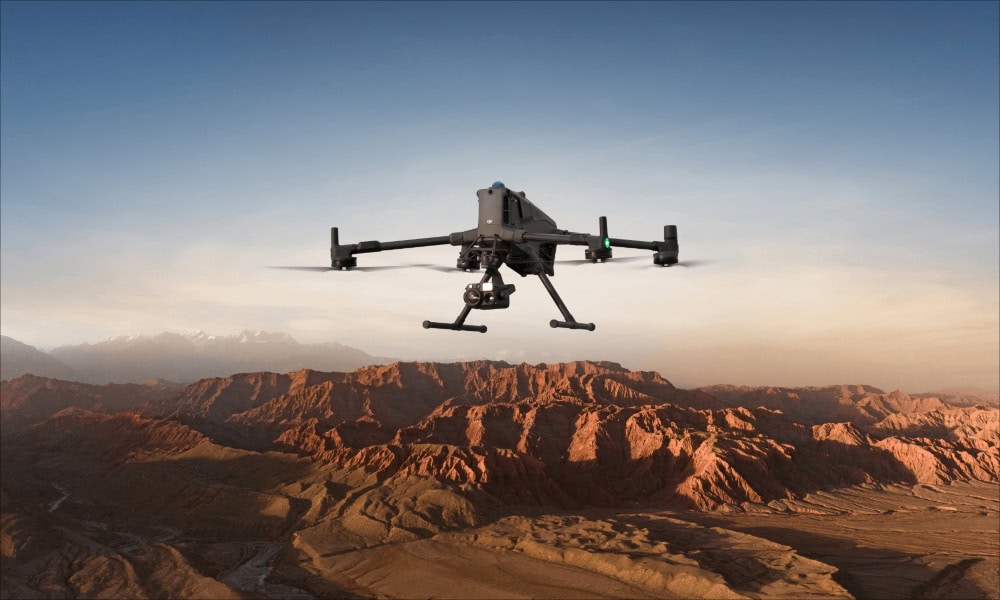
The new platform is designed to handle more complex missions with multiple payloads, and its improved transmission system means operators can cover more territory with greater confidence.
Simply put, the M400 is the M350 RTK on steroids, giving enterprise users more power, flexibility, and intelligence to tackle the most demanding tasks.
Matrice 400 Specifications
- Flight Time. Up to 59 minutes with Zenmuse H30T payload, significantly longer than the 42 minutes of the M350 RTK with the same payload.
- Payload. Maximum payload of 13 lbs (6 kg) — more than double the M350 RTK’s 6 lbs (2.7 kg) limit — and support for up to 7 payloads simultaneously.
- Transmission Range. Improved O4 Enterprise transmission to 20 km (CE), a significant improvement over the M350 RTK’s 8 km (CE).
- Weight. 21.3 lbs (9.7 kg) compared to 14 lbs (6.47 kg) in the M350 RTK, reflecting its larger size and expanded capabilities.
- Obstacle Detection. Advanced LiDAR and mmWave Radar for power line-level obstacle detection and improved low-light performance.
- Weatherproof. An IP55 rating, like the M350 RTK, ensures reliable operation in harsh environments.
- Payload Versatility . The DJI Matrice 400 supports seamless payload switching, allowing you to quickly switch between gimbals and other payloads during flight, providing unparalleled workflow flexibility.
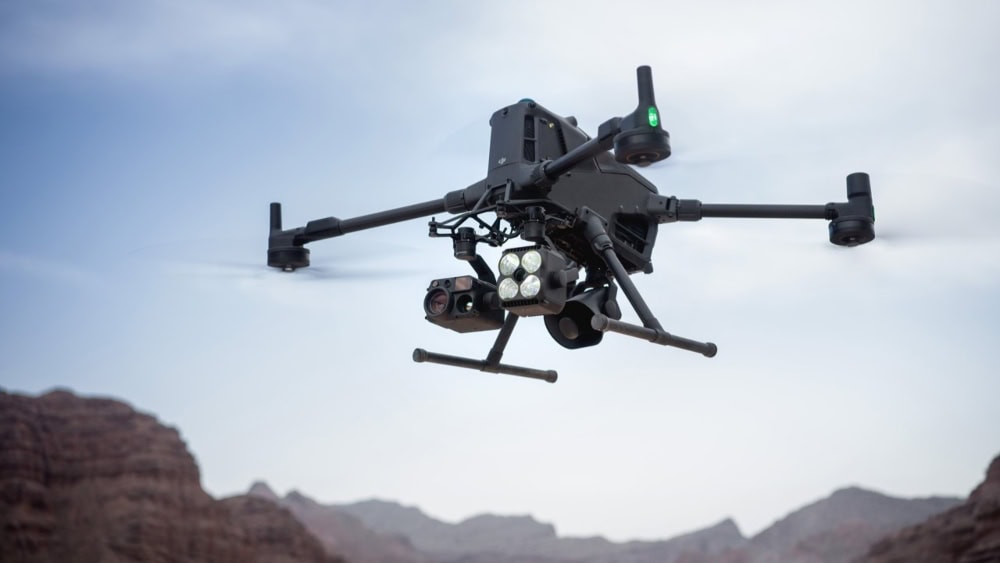
The Matrice 400 is equipped with a floodlight, loudspeaker and other payloads
The M400 can carry up to seven payloads at a time, allowing you to connect a thermal imager, LiDAR sensor or visual camera, as well as a floodlight, loudspeakers, onboard computers or third-party PSDK payloads.
It also comes with several intelligent automation features that make it a more powerful tool for commercial applications, including:
- Power Line
- Slope Routing
- Geometric Routing
- Advanced AR Projection Capabilities
How do the Matrice 400’s features compare?
Check out this table to compare it to other drones in the Matrice line.
| Function | Matrix 400 | Matrix 350 RTK | Matrix 4D/4TD | Matrix 4E/4T |
|---|---|---|---|---|
| Maximum flight time | 59 min | 55 min | ~45 min (depends on payload) | 49 min |
| Maximum load capacity | 13.2 lbs (6 kg) | 6 lbs (2.7 kg, depends on configuration) | 0.44 lbs (0.2 kg) | |
| Transmission Range | 12.4 miles (20 km, regular American League), up to 24.9 miles (40 km) with relay | 5 miles (8 km, CE), 12.4 miles (20 km, FCC) | 12.4 miles (20 km, center scale) | 15.5 miles (25 km, with enhanced 4G connectivity) |
| Weight (with battery) | 21.4 lbs (9.7 kg) | 14.3 lbs (6.47 kg) | 8.2 lbs (3.7 kg, configuration dependent) | 2.7 lbs (1.2 kg) |
| Obstacle Avoidance | Lidar, mmWave, Fisheye | 6-directional sensing | Omnidirectional, advanced sensors | Omnidirectional |
| Weatherproof | IP55 | IP55 | IP55 | None (not officially rated) |
Can you really buy the Matrice 400? (You still can’t buy the Mavic 4 Pro)
Yes!
While the Mavic 4 Pro is still not sold in the US — and probably won’t be for a while — the Matrice 400 is.
But you can’t buy it directly. Instead, you’ll have to buy it through authorized resellers.
While pricing for the Matrice 400 hasn’t been announced yet, it looks like it’ll cost around $15,000 to $20,000. (The Matrice 350 RTK costs around $9,500 to $12,000, depending on the payload you get with it.)

I wonder why you can buy the M400 but not the Mavic 4 Pro?
While the consumer-grade Mavic 4 Pro seems to have been caught in the crossfire of high U.S. tariffs (sometimes over 170%), unpredictable customs inspections, and ongoing political tensions, enterprise drones like the Matrice 400 face fewer hurdles.
This is because enterprise customers can handle higher costs, navigate complex import regulations, and demonstrate compliance with safety standards and regulations. Additionally, the political and regulatory pressures on professional industrial equipment are less intense.