
Autonomous weapons have the same operating systems and AI strike systems as Russian tanks and oil rigs.
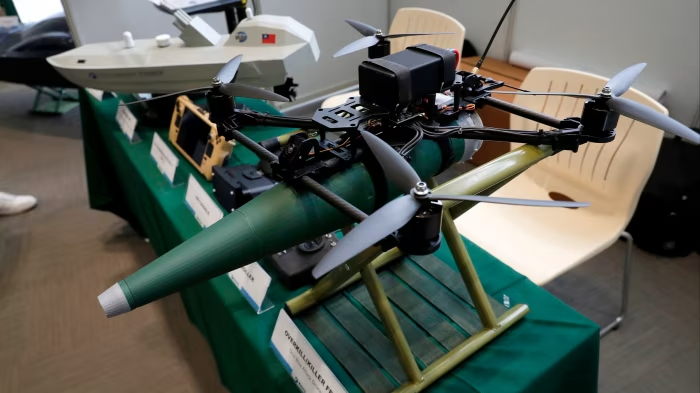
A first-person combat drone called Overkill uses the same operating systems and artificial intelligence systems as the equipment Ukraine has deployed against Russia. © Chiang Ying-ying/AP
Taiwan has developed suicide drones similar to those that underpin Ukraine’s defenses against Russia, the clearest sign of progress in the country’s efforts to rapidly build up its autonomous weapons to counter a potential attack from China. Taiwan’s Armaments Research Unit and Thunder Tiger, one of the country’s leading drone manufacturers, have completed combat testing and certification of a strike drone. It was equipped with the same systems from the US-German software company Auterion as the drones that Ukraine is using against Russian tanks and naval assets, Thunder Tiger and Auterion said. The drone, called Overkill, is equipped with an artificial intelligence strike system and Auterion’s camera. Auterion CEO Lorenz Mayer said the features give Taiwan the same capabilities that Ukraine used to destroy Russian T-90M tanks last August and to destroy a Russian oil platform radar a few weeks ago. “Here’s the weapon,” Mayer said, referring to video footage of the live-fire tests. This month, the Taiwanese military released a video of a test conducted in March of a drone jointly developed by Thunder Tiger and the National Chungshan Institute of Science and Technology (NCSIST). Details were not made public at the time. Suicide drones are maneuverable munitions that are destroyed when they hit a target. The Overkill is a first-person view (FPV) drone that is piloted by a human, unlike larger fixed-wing or flip-up drones.
While there have been major differences between Taiwan and Ukraine, Mayer said, the lessons learned from the use of Ukrainian drones are “definitely applicable” to a potential war with China over Taiwan. “If you replace a [Russian] oil rig with a Chinese destroyer, from that point on it will be a destroyer with no air defenses,” he said. This month, NCSIST and Auterion announced a multi-year agreement to jointly develop drones. But the Overkill drone shows that development is already well underway. Separately, Meyer said, Thunder Tiger has agreed to buy licenses for Auterion’s software for 25,000 drones, some of which will be manufactured for export, signaling a sharp increase in drone production in Taiwan. The country began efforts three years ago to build a domestic supply chain for military drones. It has also been working to forge closer cooperation between its drone industry and the U.S. industry. Washington is seeking to replace Chinese components in its drone supply chain, while Taipei hopes that U.S. sales will make it easier for its drone companies to build the capacity needed to meet future orders from its own military. But both initiatives have been slow to show results. According to the government-backed think tank, the Research Institute for Democracy, Society and New Technologies, Taiwan’s entire drone industry produced fewer than 10,000 units in the 12 months to April — less than 6% of its 2028 target. Thunder Tiger General Manager Jin Su called the 25,000 units mentioned by Meyer “a rough figure,” but confirmed that the company was in talks with several potential export customers. “We think exports are a very big opportunity in the near term in Southeast Asia,” he said, naming the Philippines, Vietnam, India and Indonesia as potential markets. “None of them want Chinese parts.” Su added that he was confident that Taiwan’s military would buy a large number of drones once parliament approved a special budget for arms purchases. The government is expected to present a budget this autumn.