
Drone Entrepreneur Wants to Save Europe with Smarter Combat Robots
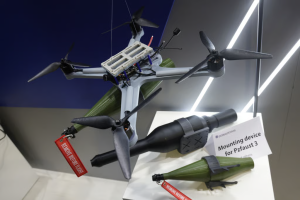
“Drones will have to take the next step in evolution: to identify targets on their own, classify them as friend or foe, and in case of trouble, to strike them,” said Florian Seibel |Sean Gallup/Getty Images
Florian Seibel has seen the future of war — and it includes robots. Now he wants to convince Ukraine — and Europe — that they need to embrace autonomous weapons.
Seibel, 44, a former helicopter pilot in the German army, is the chief executive of Quantum Systems, a Munich-based company whose investors include Silicon Valley wizard Peter Thiel. The company makes reconnaissance drones that Ukraine is using to repel Russian incursions.
The numerical disparity between the armies of democracies and those of China and Russia, he says, will make reliance on robots necessary “to cope with the reduced number of our fighters.”
He has founded a new company called Stark Defense, which specializes in combat drones that can operate without human control. Although he says the company was named after Arya Stark, the heroine of the fantasy book series “A Song of Ice and Fire” and its television adaptation “Game of Thrones,” it is also a reference to the Marvel comics superhero-industrialist Tony Stark.
Stark’s mission, Seibel told POLITICO last month, is to “disrupt the defense industry and create autonomous systems on land, in the water, on the surface,” all with strike capabilities.
Stark’s launch comes at a crucial juncture in the history of autonomous weapons. With geopolitical tensions escalating, Ukraine’s skillful use of drones making headlines, and the rise of artificial intelligence technology, militaries including the United States, China, and Russia are eagerly looking at the possibilities of building autonomous capabilities.
Drone warfare is losing its edge
About 400 Quantum Systems drones are already flying in Ukraine, with another 800 to be delivered in August under a deal struck during a mission organized in April by German Vice Chancellor Robert Gabeke. The company is also opening a factory in Ukraine.
Russia’s development of jamming techniques that can prevent drones from navigating or communicating with pilots has convinced Seibel that the remotely piloted drones that Ukraine has long relied on are now losing their edge.
Artificial intelligence, a rapidly evolving technology that can detect patterns and make decisions, has provided a lifeline. Thanks to AI and Nvidia chips, Quantum Systems drones can navigate the battlefield and identify targets without relying on GPS or a human pilot. They can then fly independently to a location free of obstacles and send back suggested Russian military targets for artillery strikes.
The final decision still rests with Ukrainian soldiers, under a model known as “man in the loop,” meaning that killing decisions should be made by humans, not machines.
But Seibel believes that this norm must change. “If they can’t communicate with each other,” he said, “drones will have to take the next step in evolution: to identify targets on their own, classify them as friend or foe, and in case of trouble, strike them.”
In his view, the price of not developing a weapon that can do this—managing the entire chain of killing, from target selection to strike—is to start the next war as outsiders. “If we don’t want our children to fight against Chinese combat robots in the future, we should start working on combat robots ourselves,” Seibel said.
Russia is developing jamming methods that can prevent unmanned vehicles from navigating. | Stringer/Getty Images
Ban on combat robots
At the same time, diplomats, activists and technologists want to limit the technology, worried that it will lead to an escalation of AI-driven warfare, push-button mass killings, self-inflicted gunfire disasters and morally repugnant algorithmic death.
The Austrian government is leading efforts to draft an international treaty that would ban autonomous weapons that cannot be controlled or predicted by their human masters.
“We don’t need arms manufacturers claiming that unpredictable and unethical weapons will make Europe safer,” Anna Gehir, head of the autonomous weapons program at the Future of Life Institute, a think tank, told POLITICO.
“There was a time in history when major military powers thought they needed biological weapons to counter their adversaries’ own biological weapons programs. We need to maintain a rational foresight when evaluating new technologies.”
Autonomous weapons, if designed properly, could reduce collateral damage by leveraging the superior analytical capabilities of artificial intelligence, Seibel said: an AI-powered drone could tell friend from foe, or civilian from combatant, with greater accuracy.
“These discussions are similar to the discussions about autonomous driving: human nature is skeptical, and if something is new, it must be bad,” he said. “I think it’s the opposite: autonomous weapons can make much smarter decisions.”
Hehir said that if military AI achieves superhuman accuracy, it will require even stricter checks on the technology to prevent it from being used for “targeted killings” based on certain characteristics.
The Case
Stark is still recruiting and seeking venture capital, but Seibel said it could deploy its products on short notice if needed, especially if Ukraine approaches them. In the meantime, he’s making a case to senior leadership.
“We’re talking again tonight in Berlin with General [Carsten] Breuer, the commander-in-chief of the German armed forces. We’re telling them that the next war will be all about drones,” Seibel told POLITICO in May. “They’re starting to act, but very slowly. To be honest, they haven’t started to act yet.”
“Ultimately, these systems are capable of operating without human intervention. But that is not my decision: we will prepare the ground for that to happen,” he said. “But if the decision of the German government is that we cannot have autonomous weapons without a human in the loop, then they will not be used.”