
Buzzing into enemy territory.
China has unveiled a mosquito-sized drone designed for covert military operations and espionage, a development that has raised concerns about the potential consequences of the technology falling into the wrong hands.
The miniature device, with two leaf-like wings, a black vertical body and three hair-thin legs, was designed by scientists at the National University of Defense Technology in China’s Hunan province to mimic the insect’s blood-sucking cells.
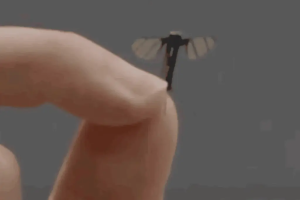
The miniature device has two leaf-shaped wings, a black vertical body and three thin legs.China’s NUDT
“Here’s a mosquito-like robot in my hand,” said Liang Hexiang, a NUDT student who held the tiny drone between his fingers in a video released by state media last weekend.
“Miniature bionic robots like this are particularly suitable for intelligence and special missions on the battlefield.”
He said the hair-raising device could be used for a wide range of military and civilian missions.
The nanowing drone is equipped with ultra-miniature cameras and microphones to capture images, sounds and electronic signals — its tiny size makes it nearly invisible to the naked eye and capable of flying past conventional radar systems undetected.
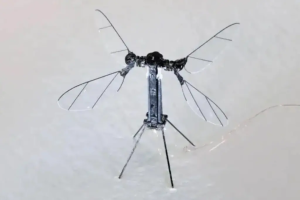
The nanowing device was designed to mimic a blood-sucking insect.China’s NUDT
Despite the technological leap, experts have warned of serious security risks that the drone could pose.
“If China can produce mosquito-sized drones, it will likely be interested in using them for a variety of intelligence, surveillance and reconnaissance tasks, especially in places where larger drones have difficulty accessing, such as indoors,” Sam Bresnik, a research fellow at Georgetown University, told The Telegraph.
“These drones can be used to track people or listen in on conversations.”
Timothy Heath, a senior defense researcher, warned that criminals could use the microdrone to steal personal information, including passwords, or to infiltrate businesses.
However, Heath noted that the device’s small size could limit its operating range and durability.
“To spy for an extended period of time, someone would have to be willing to constantly turn off the microdrones, recharge and redeploy them, and review the data they’ve collected, all within reach of the targeted individual or business,” Heath told the publication.
“That’s why the drone is less useful on the battlefield but more useful for special operations or espionage missions.”
The new creepy drone comes just over a month after China released images of an airship designed to launch more than 100 drones and about 2,200 pounds of missiles at cruising altitude.
The Jiu Tan SS-UAV has a massive 25-meter wingspan and is designed to fly over many medium-range air defense systems around the world.